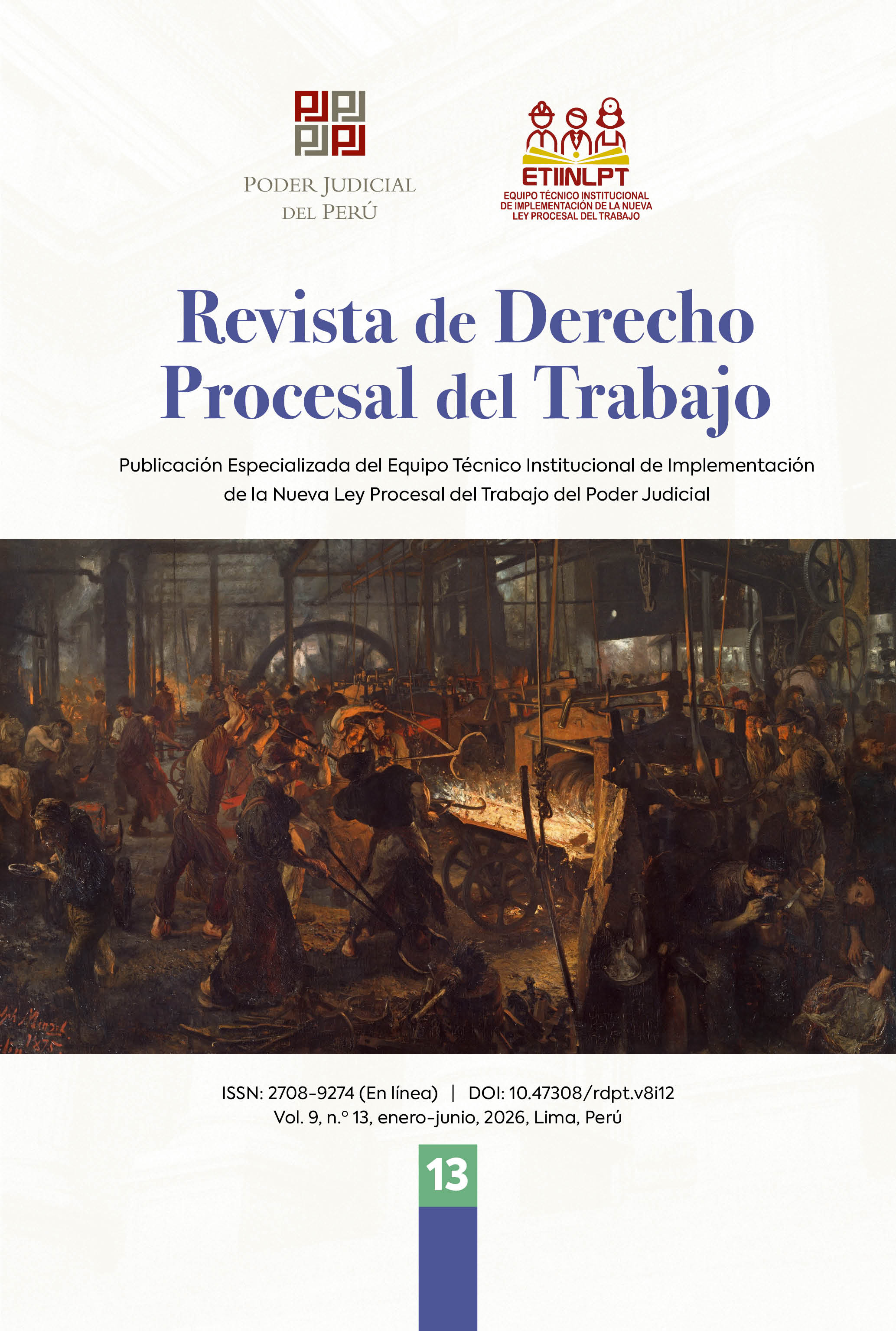
Substantial modification of working conditions in Peru: current problems and the need for regulatory action
Abstract
This paper is motivated by the need to regulate the procedure by which an employer may substantially modify the terms of employment governing the relationship between the employer and the employee, given that the relevant regulations have not been amended since 1995. This paper addresses the essential elements of the employment contract, namely, the personal provision of services, compensation, and subordination, the latter of which underpins the employer’s managerial authority in governing the employment relationship. Working conditions can be classified as non-essential or essential. The former may be unilaterally modified by the employer based on the employer’s authority known as ius variandi; an example is a change in a worker’s duties. In the case of the latter, they cannot be unilaterally modified by the employer, since doing so would radically alter the employment relationship. It has been concluded that there is a need to establish regulatory guidelines for the procedure an employer must follow to substantially modify working conditions, thereby preventing arbitrary actions that could harm the employee.
Downloads
References
Arce, E. (2007). Modificación de la prestación de trabajo. Un estudio sobre las modificaciones sustanciales. Revista Ius et veritas de la PUCP, (34), 124 – 135. https://revistas.pucp.edu.pe/index.php/iusetveritas/article/view/12313/12878.
Boza, G. (2016). La modificación unilateral del contrato de trabajo por iniciativa del empleador. Una especial atención al ius variandi extraordinario. Revista de ponencias del VII Congreso Nacional de Derecho del Trabajo y de la Seguridad Social de la SPDTSS, 693-723. https://www.spdtss.org.pe/congreso/vii_congreso_nacional/
Ferrero, V. (2019). El Derecho individual del trabajo en el Perú. Fondo Editorial PUCP, Lima.
Gonzales L. y Tarazona M. (2017). Pronunciamientos de la Corte Suprema y del TC en materia laboral. Gaceta Jurídica, Lima
Montoya, A. (1965). El poder de dirección del empresario. Estudios de Trabajo y previsión. Instituto de Estudios Políticos, Madrid.
Martín A., Rodríguez -Sañudo F. y García J. (2019). Derecho del Trabajo. Tecnos, Madrid.
Navarrete, A. (2016). Reflexiones sobre los actos de hostilidad laboral. Naturaleza jurídica, procedimiento, tipificación y carga probatoria. Revista Soluciones Laborales - Gaceta Jurídica, 56.
Noriega, K. (2020). Modificación de los elementos esenciales del contrato de trabajo en el marco del COVID - 19. Revista Laborem de la SPDTSS, (23), 79-90. https://www.spdtss.org.pe/wp-content/uploads/2021/09/Laborem23.pdf
Pizarro, M. (2019). La remuneración. Enfoque legislativo, jurisprudencial y doctrinario. Gaceta Jurídica, Lima.
Pose, C. (1995). Manual práctico del ius variandi. David Grinberg Libros Jurídicos, Buenos Aires.
Toyama, J.L. (2003). Modificación de condiciones de trabajo: entre el poder de dirección y el deber de obediencia. Revista Derecho y Sociedad de la PUCP, (21), 172-189. https://revistas.pucp.edu.pe/index.php/derechoysociedad/article/view/17368/17653
Toyama, J. (2008). Los contratos de trabajo y otras instituciones del Derecho Laboral. Soluciones Laborales, Gaceta Jurídica, Lima.
Toyama, J. (2015). El Derecho Individual del Trabajo en el Perú. Un enfoque teórico – práctico. Gaceta Jurídica, Lima.
Sánchez, R. (2017). Cómo probar la hostilidad laboral. Análisis normativo, doctrinario y jurisprudencial. Gaceta Jurídica, Lima.
Sarzo, V. (2014). La Configuración Constitucional del Derecho a la Remuneración en el Ordenamiento Jurídico Peruano. Juristas editores, Lima
Valderrama L., Hilario A., Tarazona M., Sánchez R. y Barzola M. (2016). Régimen laboral explicado 2017. Gaceta Jurídica, Lima.
Poder Judicial (2013). Sala de Derecho Constitucional y Social. Casación Laboral n.° 8283-2012-Callao. (26 de abril de 2013).
Poder Judicial (2017). Segunda Sala de Derecho Constitucional y Social Transitoria. Casación Laboral n.° 321-2017-Lima. (7 de noviembre de 2017).
Poder Judicial (2023). Cuarta Sala de Derecho Constitucional y Social Transitoria. Casación Laboral n.° 8439-2022-Lima. (25 de abril de 2023).

This work is licensed under a Creative Commons Attribution 4.0 International License.
Authors retain their copyrights and register under the Creative Commons Attribution 4.0 International License (CC BY 4.0), which allows them to use what is published (adapt - remix, transform and build - and share - copy and redistribute - the material in any medium or format).
1. The journal allows authors to retain their copyrights of submitted articles without any restrictions.
2. Authors retain the right to share, distribute, copy, perform and publicly communicate the article published in the Revista de Derecho Procesal del Trabajo (e.g., place it in an institutional repository).
3. Authors retain the right to make a subsequent publication of their work, to use the article or any part of it (e.g., a compilation of their work, notes for conferences, thesis, or for a book), provided they indicate the source of publication (authors of the work, journal, volume, number and date).